
Spring revival: A nature-based solution to improve water security and climate resilience in the Hindu Kush Himalaya


Summary
Spring revival is a nature-based solution to improve water security and build climate resilience in the mountains. Many towns and villages in the Hindu Kush Himalayan (HKH) region are facing increasing levels of water insecurity and an estimated 30–50 per cent of springs have dried up or reduced discharge over the last three to four decades, which poses a threat to local communities.
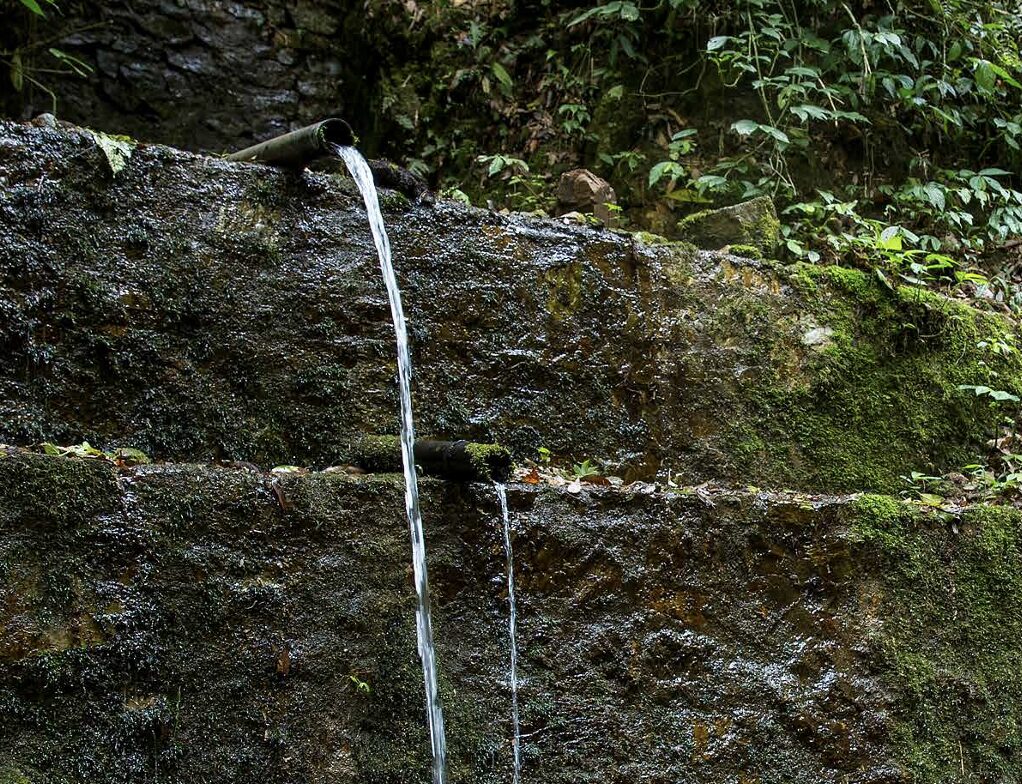
Springs are an essential source of water for mountain communities, supplying over 90 per cent of the water for domestic uses in the mid-hills of the HKH. They also provide water for agriculture and cultural or religious activities, as well as helping sustain river baseflow and biodiversity in the region. Underground aquifers supply the array of springs that emerge in the hills, and the groundwater systems are usually recharged by snow and rainfall.
Climate change has led to more intense weather events. Rainfall patterns have shifted, with more intense rainfall during monsoon season and more frequent and longer droughts. Despite some regions receiving significant amounts of precipitation (rain or snow) the springs appear to be drying up, causing water shortages that poses a threat to the communities that rely on them. Land-use, socioeconomic and demographic changes also lead to higher demand for spring water, especially in the more densely populated areas around the mid-hills of the HKH. Women are often the most affected by the water shortages, as they now have to travel further to collect water.
One nature-based solution to water shortages is spring revival in coordination with improvements in water and landscape management.
Overview
- Implementation sites:
-
- Multiple countries
- Multiple locations
- Mountain region:
-
Hindu Kush Himalayas
- Solution scale:
- Ecosystem type(s):
- Solution type(s):
- Sector(s):
- Climate impact(s) addressed:
- Other climate impact(s) addressed:
-
- Shifting rainfall patterns
- Climate impact time-scale(s):
- Main benefit associated with the solution:
- Co-benefit(s) associated with the solution implementation:
- Sendai targets:
-
- SDGs:
-
-



Solution details
Main beneficiaries & outcomes
In Sikkim, India, more than 50 springs and five lakes have been revived. Because of this, the farmers in the area have better access to water and can grow a larger variety of fruits and vegetables, which improves both their income and food security. The results in Sikkim show that increased water for better irrigation encouraged farmers to cultivate new crops, such as beans, cabbage, radish, cauliflower and chilli, along with rice paddies and tomatoes. Crop yield has increased by 15 per cent and cultivation of irrigated crops by 25 per cent. Farmers have also cultivated perennial fruits, such as guava, banana, orange and litchi, following the success of the initiative. This resulted in greater understanding of groundwater infiltration and the relationship between ponds upstream and springs below, both for researchers and for the local community. Similar positive results have been seen in pilots in Nepal and Bhutan.
Planning and implementation
The spring revival solution is designed to significantly increase and improve water supply and water quality over several years. This solution entails a combination of hydrogeological, social and governance aspects.
Successful implementation of the solution requires the following 6 steps:
- Comprehensive mapping of springs and springsheds – the initial phase is to map springs in the area that is suffering from the drying of existing water sources.
- Setting-up of a data monitoring system – to be able to assess the current situation, and later on the effectiveness of the revival, it is important to start monitoring the water discharge from the spring, as well as precipitation, before any further steps are taken.
- Understanding social and governance aspects – a key component of spring revival is understanding social conditions and structures; this will help guarantee success and ensure that it will provide equal access to water. Training in restoring and maintaining the spring can be organized by the community members. Forming a spring-shed management committee consisting of trained community members will often ensure the sustainability of the solution. Equal representation across genders and vulnerable groups within the community in the training and the spring-shed management committee is required to increase equal access to water.
- Identification of recharge areas – parallel to the training and committee formation, an understanding of the groundwater system and the water infiltration that recharges the spring is needed.
- Implementation of recharge measures and management protocols – this requires inputs from professionals, such as hydrogeologists, who can help determine the key locations to carry out the work. Providing simple hydrology training for local community members also builds capacity and strengthens their resilience.
- Measuring the impact of spring revival – following spring revival through structural, vegetative and management measures, discharge, rainfall and water needs must be continuously monitored to measure the success of the revival and to assess whether more springs need to be revived in the area to ensure water accessibility to all.
Development activities, such as building roads and other infrastructure, can affect the groundwater supply of nearby springs. Therefore, it is crucial to include water security aspects in the planning from the outset. Other major concerns are forest degradation and other land-use changes, as well as excessive groundwater mining.
Finance
Information not provided
Innovation
Information not provided
Long term project sustainability and maintenance
Community members play a key role in restoring and maintaining the spring. To ensure long-term sustainability, a spring-shed management committee consisting of trained community members can be set up. Spring revival management activities usually require collaboration among multiple stakeholders, including upstream and downstream communities, residents of more than one watershed, and authorities of different administrative units. Scaling spring revival solutions upward and outwards in the mid-altitude mountains will benefit the rivers and communities downstream and help prevent future drought. Some incentive-based mechanisms might be needed between spring users and recharge area users to avoid conflict and ensure mutual benefits.
Capacities for design and implementation
Knowledge
Scientific knowledge is important in understanding the groundwater system and in identifying locations to carry out the spring revival solutions. However, it is equally important to build local capacities for the solution’s long-term sustainability. For example, by providing simple hydrology training to local community members.
Institutional
Spring revival projects can suffer without adequate and long-term institutional support from local and national governments to cover a wide geographical area and large financial needs. From the start, activities should be carried out in close cooperation with other institutions involved in similar work, such as local government and local non-governmental organizations. Financing is also crucial and should be included in annual budgets.
Socio-cultural
Local participation and control, particularly among women and marginalized groups, is important at all stages of the spring revival and management process to avoid exacerbating inequalities and to empower communities.
For example, women and marginalized members of the community should be included in the water user and management groups. Usually, women are in charge of the household water supply, so a decrease in spring water levels directly affects them as they may need to travel further to fetch water. Because women are the ones who fetch the water from springs, they have extensive knowledge of the springs and of water demand.
Outlook & Scalability
Barriers and adverse effects
There is an increased awareness of spring flow depletion, deteriorating water quality and spring conservation measures at the local level. However, technical capacity and knowledge is often lacking, particularly for defining the extent of the recharge area. Such work is currently carried out by hydrogeologists and experts from outside the region. Therefore, addressing issues with the spring revival solution requires effort and coordination from policymakers, specialized hydrological organizations and local authorities.
Additionally, anthropogenic factors, such as the increased use of agrochemicals and waste disposal, can lead to contamination of spring water. This results in adverse impacts on both human and environmental health and requires increased investments for water treatment. Sound local-level water management is also crucial to avoid discrepancies, inequalities and other social issues, such as upstream/ downstream conflicts.
Potential for upscaling and replication
The springshed revival solution has already been out-scaled to new locations in Bhutan, India and Nepal following the six-step protocol. Spring revival, using local and hydrogeological knowledge, was also included as a major intervention under the Royal Government of Bhutan’s 12th Five Year Plan (2018–2023) for the renewable natural resources sector. The results indicate that the solution could succeed throughout the HKH region.
- Increasing agricultural viability and climate resilience through community seed banks in Nepal
- Resilient women for resilient mountain villages: A holistic approach to climate change adaptation in Nepal
- Solar powered pumps for irrigation in Pakistan
- Adapting to dry spells with low-cost ponds in Nepal
- Renewing the flow of water in Mireshelli, Azerbaijan
Comments
There is no contentYou must be logged in to reply.