
Glaciers in the spotlight: Reflecting on a glacier, a football match, old fears and new loss


To highlight the UN International Year of Glacier Preservation, the Adaptation at Altitude programme is collecting and sharing stories from the glaciers to highlight peoples experiences with their local glaciers.
Otto Simonett’s story
Read Otto’s story reminiscing about the Swiss alpine Glatscher da Lavaz, the glacier of his youth.

Otto Simonett
Otto Simonett (Otto Gonzales de la Sierra) is from the Grisons canton in Eastern Switzerland. He is the co-founder and director of Zoï Environment Network, which partners with SEI and others in the Adaptation at Altitude program.
In the summer of 1974 – finally – I was old enough to participate in a Jugend+Sport (youth and sports) mountaineering camp in the Grisons, Switzerland. It was an adventure in itself to spend a week in the mountains with mostly older kids and well-weathered, old-school mountain guides in and around the Camona de Medel (mountain hut) of the Swiss Alpine Club.
But the absolute highlight was something else: being exposed to real glaciers. What if one of us were to fall into a crevasse? We were taught not only precaution (“Always walk with the rope tight.”) but also real mountain rescue skills. We received training on how to pull somebody out of the crevasse with an improvised pulley using ice axes, cords, and the metal climbing clips, carabiners. All this was spiced up by after-dinner storytelling, mostly tales of horror about death in the mountains or at least some frozen or amputated limbs. What we basically learned was this: glaciers put your life at high risk.
In the same year, 1974, the World Cup football tournament matches were held in Germany, and the finals coincided with one the days of our camp. Back at the hut, the only connection to the world was a tiny transistor radio with lots of static noise. Nevertheless, this allowed us to be part of the dramatic action on the lawn in Munich, where the Netherlands lost 1:2 to Germany. All the people in the camona were rooting for the Netherlands. Thus, there was some disappointment in the alpine air after the match. Never mind, we had our glacier experience during the day, and with that, who cares about world football? Since then, whenever I come across the names of Johan Cruyff or Franz Beckenbauer I associate them with glaciers, although in their real lives as footballers they probably had very little to do with snow and ice.

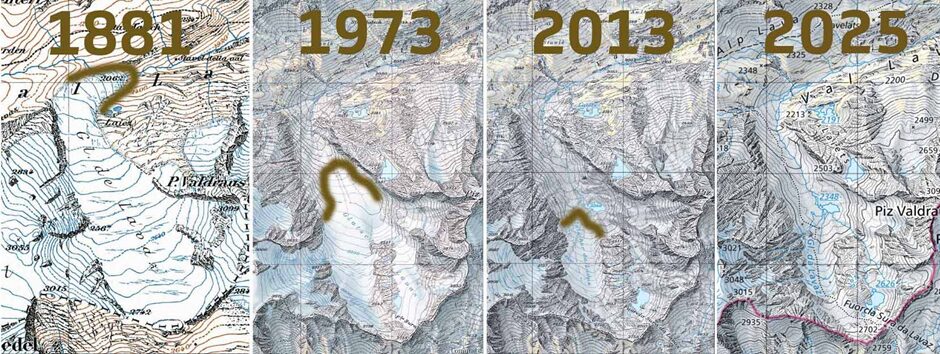
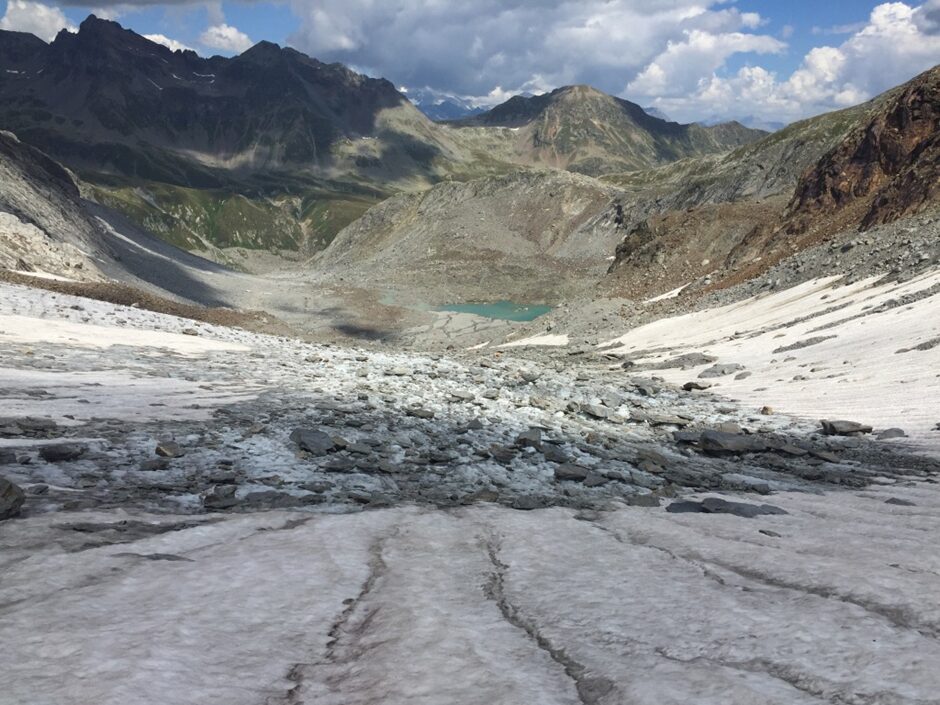
Hiking the same area roughly half a century later I was saddened to see how the snow and ice has disappeared, as is the case in all the places in the Alps we hike in the summer. The Glatscher da Lavaz, one of the glaciers we used for training in our camp, today is completely gone. Only some tiny patches of dirty snow remain. Looking at them, it is hard to imagine that we used to cross this very place only on ropes and wearing crampons – or that we were on the constant outlook for crevasses.
To witness climate change in such a concrete and brutal way within my own lifespan – in terms of football this has happened within the span of only 12 world championships – remains a shocking experience. The fear of the ascending alpinist has been replaced by mourning.
Further resources

Comments
There is no contentYou must be logged in to reply.