
Mountains in Motion: Global Linkages from Ridge to River

This article was originally published on the UNEP website here. Please access the original text from the featured document on the right hand side for more detail, research purposes, full references, or to quote text.
Summary
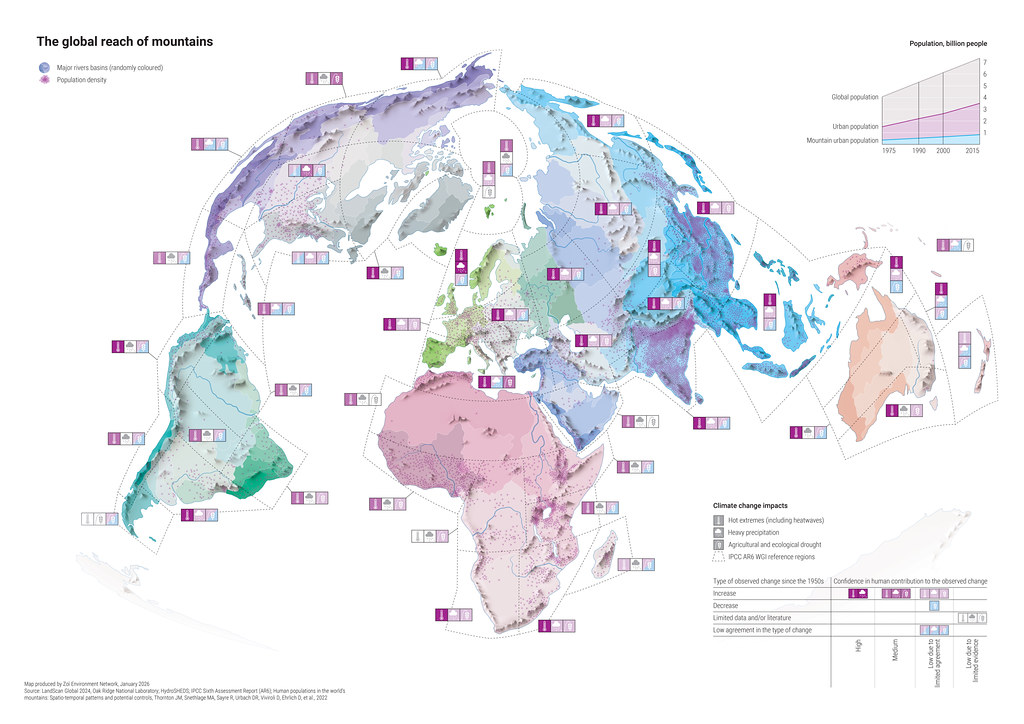
Mountain ecosystems are critical intersections in global systems, linked to planetary health and human well-being far beyond their ridges. They function as water towers, supplying freshwater for downstream agriculture, energy, and urban centres, thereby inextricably linking ecosystem health to food, energy, and economic security. This publication sheds a light on the interconnection of challenges to better understand the cascading effects of a changing climate and environmental conditions. Human driven global warming causes rapid cryosphere decline and accelerates biodiversity loss by forcing some species to move to higher altitudes. Simultaneously, pollution, from long-range atmospheric deposition to local tourism waste, exacerbates ecosystem stress and may accelerate snow and ice melt. Links between the triple planetary crisis in mountain regions and the rest of the planet are identified, moving beyond a siloed analysis. The publication leverages recent data from top-tier peer-reviewed journals, public databases and Rio convention reports, to quantify the “ridge-to-river” cascade of impacts, building a compelling case for action. It provides a decision-making tool for translating science into policy-ready options, responding to future scenario modelling and mountain-specific indicators. Identified solutions recognize the key role of women, Indigenous Peoples and Local Communities and youth in shaping sustainable mountain futures.
This report is structured to guide the reader from understanding the challenges to identifying solutions. It begins by describing climate change impacts and trends in mountain regions, then analyses present and future challenges for biodiversity, describes the human-made pressures of pollution and land degradation, and examines international environmental governance in specific mountain regions. Throughout the report, map-based case studies illustrate the linkages between mountain regions and lowlands, supported by data that help to better grasp the challenges and solutions identified.
For in-detail information please access the Mountains in Motion report from the featured document section on the right hand side.
Motions for change
Mountains are vital planetary life-support systems inextricably linked to global stability, sustainability, and human well-being, not isolated realms. As this linkages report demonstrates, the impacts of climate change, biodiversity loss, land degradation, and pollution are interlinked and cascading and they
do not respect national and geographic boundaries. The cryosphere’s decline dictates water security
for billions downstream, while the loss of mountain biodiversity undermines ecological resilience across
continents. Pollution affects the health of people, plants and animals, whereas measures to tackle
land degradation carry important livelihood, nature and carbon sequestration co-benefits.
Accelerated action on sustainable mountain futures is essential because climate change, land degradation and rapid socio-economic change are already pushing natural and human systems close to their adaptive limits, a situation that would be exacerbated under a middle of the road climate scenario and potentially catastrophic in a high-emissions pathway. In such scenarios, rising temperatures, accelerated glacier loss, water scarcity, extreme events and ecosystem collapse may exceed the capacity of ecosystems and communities to adapt incrementally, undermining livelihoods, food and water security, and long-term development gains.
Adaptation in mountains is therefore not only a technical challenge but a transformative one: it requires deep cultural, socio-economic and institutional change, including shifts in land use practices, livelihood strategies, governance arrangements and risk management systems. These transformations take time, sustained investment and strong institutions, and delays in action will increase costs, reduce options and heighten the risk of irreversible losses and damages for mountain populations and downstream societies alike.
Investing in the protection and sustainable management of mountain ecosystems and strengthening the resilience of Indigenous Peoples and Local Communities is therefore not merely a local, national, or regional concern, but a strategic global imperative. These investments generate amplified returns by safeguarding the critical ecosystem services that underpin whole economies and societies.
Water Security: Mountains provide freshwater to more than 60 per cent of people on Earth. Protecting the watersheds through forest conservation, waste management, restoration and sustainable land-use is fundamental for agriculture, industry, energy and cities far beyond the peaks and valleys themselves.
Climate Resilience: Mountain ecosystems act as carbon sinks, regulators of local weather and unique refugia for biodiversity. At the same time, they are sensitive to climate risks and disasters. Their conservation is a powerful Nature-based Solution for climate mitigation and adaptation, helping to buffer surrounding regions against extreme weather events and climatic shifts.
Regional Stability and Cooperation: The transboundary nature of mountain resources, particularly water, presents a powerful opportunity for cooperation. The Rio Convention framework provides a basis for countries to consider how they can contribute to global goals while addressing regional priorities. By ensuring stable water supplies, sustaining livelihoods, and fostering dialogue, collaborative mountain governance can build trust and reduce the potential for conflict between nations that share these vital basins. This makes mountains critical landscapes for building long-term resilience, cooperation, and regional stability.
Further resources

Why glaciers matter – and the new push to protect them




Melting Heritage: Adapting to a changing snow and ice cover in the South Caucasus
Comments
There is no contentYou must be logged in to reply.