
Eco-friendly bricks and disaster-resilient houses in Nepal



Summary
The production of fired bricks is a major source of emissions. These bricks are also relatively expensive, which means fewer people can afford disaster-resilient housing. In come compressed stabilised earth bricks (CSEBs), which are less polluting and cheaper to produce and disaster resilient. The manufacturing of these bricks is also a viable business if there is capacity, investment, and a market for this product. Entrepreneurs in Nepal have been capitalising on this opportunity – selling bricks, creating jobs, and reducing emissions.
Almost half of the housing stock in Nepal does not meet safety standards because of unaffordable construction materials, chief among them fired bricks. This leaves millions at risk of disasters, which are being exacerbated by climate change. Moreover, the manufacturing process of such bricks is a source of concern in itself, given that it accounts for 37% of CO2 emissions in Nepal, contributing to warming, air pollution, melting of Himalayan glaciers, and disasters. Therefore, the brick industry’s polluting nature and the affordability of fired bricks are major issues that contribute to climate-induced disasters and disaster-prone housing.
For up to date information on this solution please visit the project website here: Build up Nepal – Climate-friendly homes and resilient livelihoods.
Overview
- Location:
- Implementation sites:
-
- Single country
- Multiple locations
- Mountain region:
-
Himalaya
- Solution scale:
- Ecosystem type(s):
- Solution type(s):
- Sector(s):
- Climate impact(s) addressed:
- Climate impact time-scale(s):
- Main benefit associated with the solution:
- Co-benefit(s) associated with the solution implementation:
- Implementation timeline:
-
- 2023 - 2023
- Sendai targets:
-
-

- SDGs:
-
-
Solution details
Main beneficiaries & outcomes
As of 2022, Build up Nepal have engaged 306 entrepreneurs, who have built 8,120 houses, created 3,170 jobs, and saved 74,227 tons of CO2 emissions. This marks significant progress, up from 6,009 houses till 2021, demonstrating the scalability of this solution.
As a large segment of the Nepali population is entering the middle class, they are leveraging their demand for low-cost housing to grow the compressed stabilised earth bricks (CSEB) market. Moreover, as many south Asian countries have begun imposing limits on fired brick production, an increased demand for CSEBs, which are cheaper, stronger, and more eco-friendly, is expected. Thus not only is this solution enabling local communities to better adapt and prepare for climate-exacerbated disasters, it is helping mitigate climate change by reducing CO2 emissions in the brick-making industry.
Planning and implementation
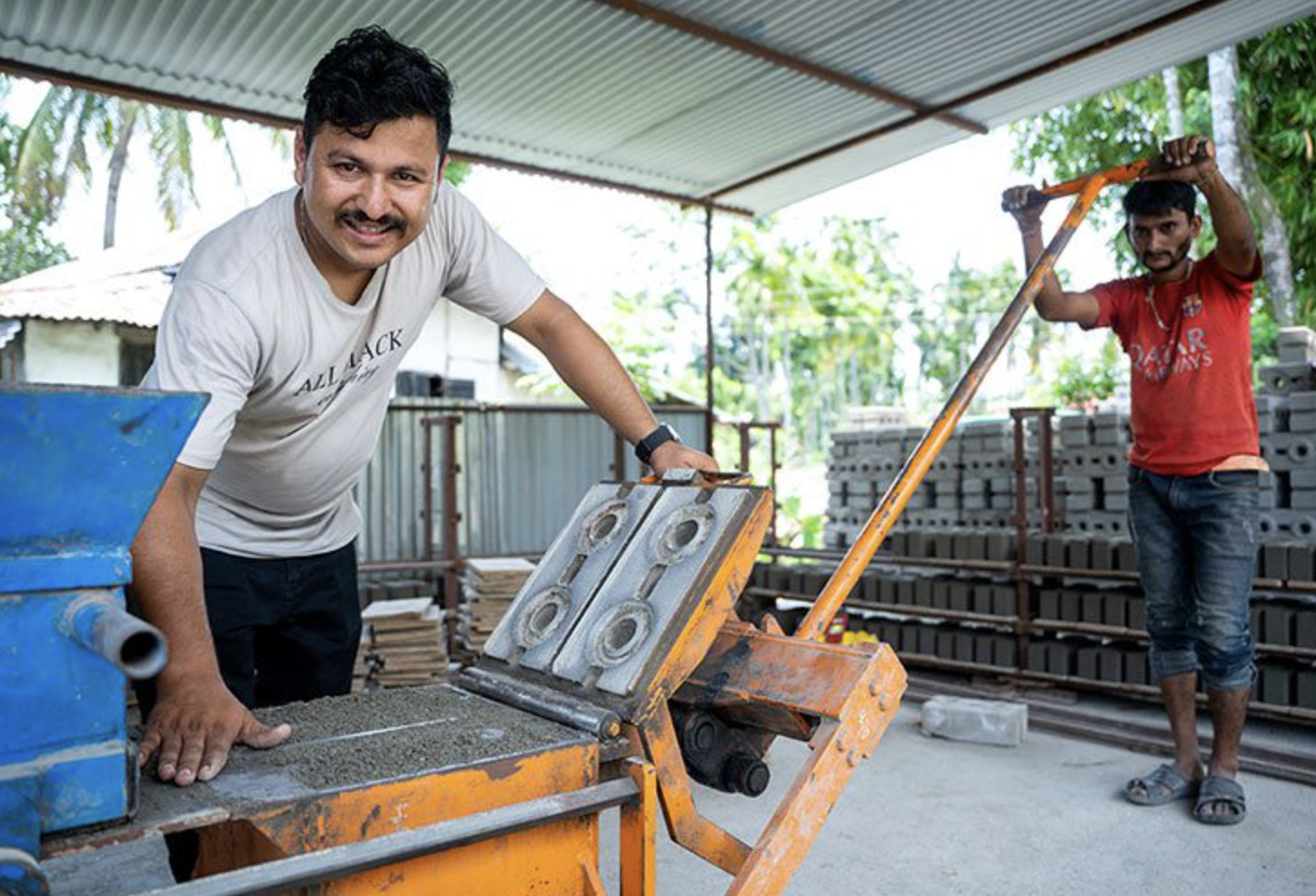
Build up Nepal helps communities build green, safe, and affordable houses by replacing fired bricks with compressed stabilised earth bricks (CSEBs). CSEB Interlocking bricks, is a recognized climate friendly and disaster resilient technology. Nepal approved the CSEB technology in 2017. It is also approved and widely used in India, Thailand, Malaysia, New Mexico, New Zealand among other countries. CSEB Interlocking bricks are produced locally by compressing a mix of sand and soil (or stone-dust, a recycled construction waste) with 10% cement in a machine. After compression, the bricks are stacked and cured (watered) for 21 days, the cement sets and bonds with the sand stabilizing the brick. No fuel or burning is required and half the cement-mortar in construction means 50-80% less CO2 emissions than fired bricks.
Disaster resilience: When building with CSEB the bricks interlock just like LEGO. Vertical rebar is anchored in the foundation and placed evenly throughout the walls, connected with horizontal seismic bands interconnecting the house, making it highly earthquake resistant. In flood prone areas the foundation is also raised to avoid the effects of monsoon flooding, intensified by climate change. CSEBs are also cheaper than fired bricks (around 25% cheaper in housing construction, depending on house size and type). This solution thus offers sustained benefits through contributions to emission reduction, lower costs, and making climate-resilient housing more affordable.
Build up Nepal sells machines for CSEB production, along with providing training and support packages, to local entrepreneurs in Nepal. The entrepreneurs then manufacture the bricks, sell them, and build houses, which are especially popular with low-income families. This solution reduces CO2 emissions and provides disaster-resilient housing while fostering local empowerment. The organisation also assists entrepreneurs in creating a market of trust for this technology by introducing local governments to its benefits, constructing demonstration houses, and conducting social media campaigns promoting the technology.

Finance
N/A
Innovation
The technologies used in this solution to create the less polluting compressed stabilised earth bricks are innovating in themselves, driving a shift away from conventional brick-making practices and creating a new market.
Another innovating aspect of this solution is that it benefits both climate change mitigation and adaptation. The production of fired bricks is not only a major source of emissions, but also their high costs are preventing low-income families from making their homes more climate and disaster resilient. Thus by making bricks more affordable, and stronger in their design, the solution also increases the likelihood of infrastructure being able to withstand natural disasters and future climate change impacts.
Capacities for design and implementation
Knowledge
Build up Nepal provides training and support packages to local entrepreneurs in Nepal to further their expertise on how to construct and implement CBES. This also fosters knowledge sharing in local communities, as more and more people are trained on the benefits and use of the new technology.
Technology
Access to the technologies required for CBES production is key to the success of this solution. Build up Nepal sells such machines to local communities, but their widespread availability requires investment and a viable market in the long-term.
Outlook & Scalability
Potential for upscaling and replication
Build up Nepal currently have 306 enterprises that are operating and growing, with the technologies being used and replicated across local communities in Nepal. To continue to expand and become the dominant brick-making practice, CBES relies on investment and a viable market.
Comments
There is no contentYou must be logged in to reply.