
Managed honeybee pollination in the Hindu Kush Himalaya
This solution is also based on 'Solution 3: Managed honeybee pollination' from Resilient Mountain Solutions: Ten local solutions for global impact. The original text can be downloaded from the right-hand column. Please access the original text for more detail, research purposes, full references, or to quote text.


Summary
An estimated three quarters of the world’s crops and over 80 per cent of all flowering plants depend on animal pollinators, especially bees. Bees also contribute to an extensive list of sustainable development initiatives, including biofuel production, income diversification, inspiring innovation in industry and infrastructure, and providing support to many ecosystem services.
Honeybees are one of the most efficient providers of crucial and high-value pollination service. They enhance the production of many economic crops such as fruits and nuts, vegetables, pulses, oilseeds, spices, and fibre and forage crops, which make up a large part of the agricultural produce of many countries in the Hindu Kush Himalaya (HKH) region.
However, pollination services are under threat due to a declining number and diversity of bees and other pollinators affected by the use of chemical pesticides, loss of habitat and other threats. This reduces agricultural productivity and disproportionately affects indigenous communities and local subsistence farmers.
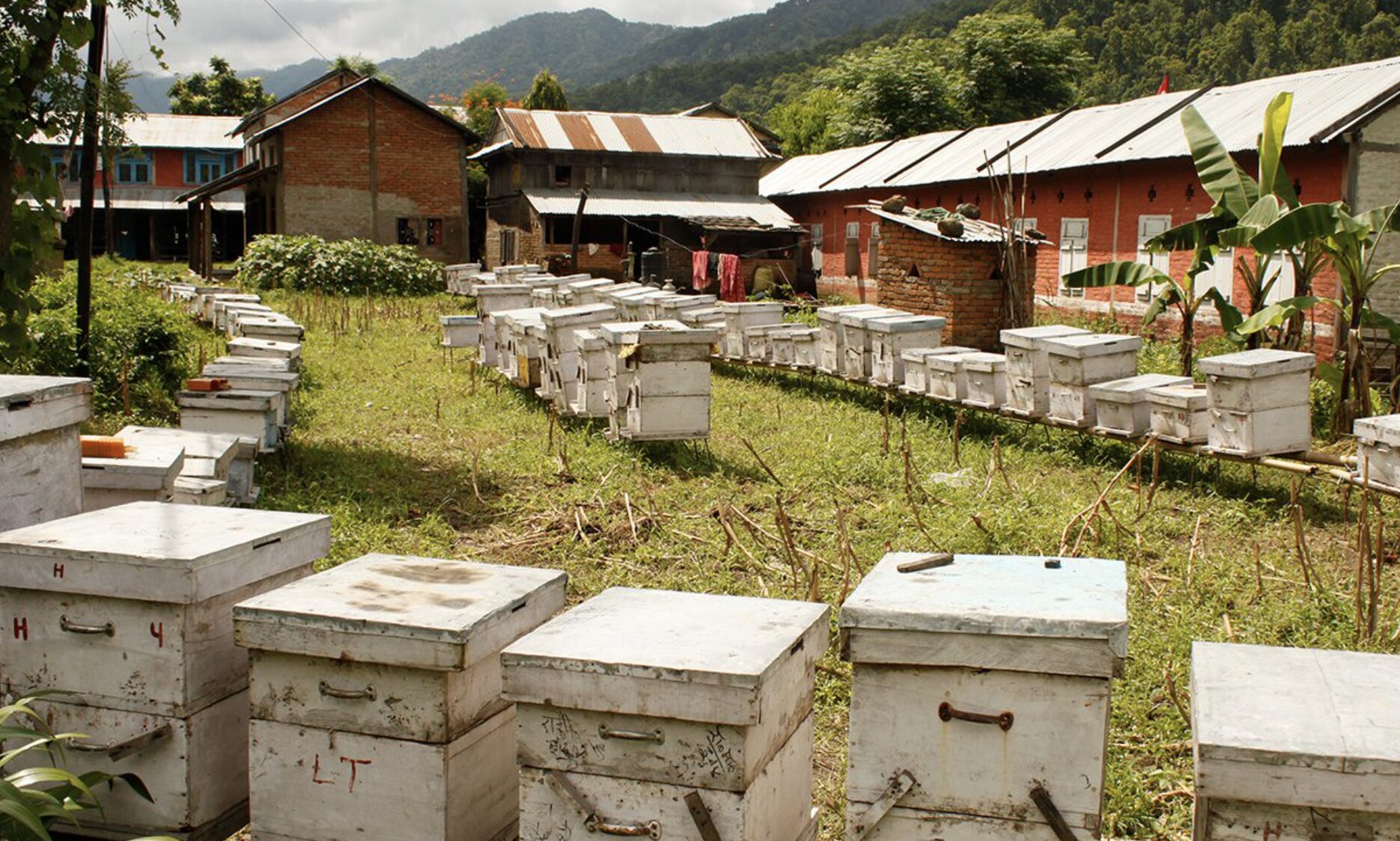
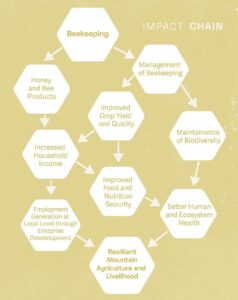
The solution was a simple one – introduce honeybees into the farm ecosystems by promoting beekeeping enterprises among farmers. This not only increases crop yields but provides farmers with an alternative income source – the honey from the hives. This is both beneficial to the environment and the farmers.
Overview
- Location:
- Implementation sites:
-
- Multiple countries
- Single location
- Mountain region:
-
Hindu Kush Himalaya
- Site locations:
-
Chitral, Pakistan; Avital in Dadeldhura, Nepal; Kishoreganj area of Bangladesh; Kalu Valley of Himachal Pradesh, India.
- Ecosystem type(s):
- Solution type(s):
- Sector(s):
- Climate impact(s) addressed:
- Climate impact time-scale(s):
- Main benefit associated with the solution:
- Co-benefit(s) associated with the solution implementation:
- Sendai targets:
-
- SDGs:
-
-

Solution details
Main beneficiaries & outcomes
Managed honeybee pollination creates multiple benefits. This includes improved quality and yields of food crops and flowering plants and the replenishment of soil. A farmer from Booni Gol Lotdur village in the region of Chitral, northern Pakistan reported that:
“The quantity and quality of my fruits are better with beehives; I would like to have more in the future. With experience now, I know that there could be a tree disease, pest and insects or a natural disaster that impacts my production. With beehives, the harvest is more constant and keeps the average higher.”
Managed honeybee pollination creates a win-win situation for both farmers or orchard owners and beekeepers. The latter may rent their bees for pollination services, whereas farmers and orchard owners benefit from improved crop yield and quality. Managed bees can also help revive the wild bee population if efforts are made to promote agroecological practices and integrated farming.
Additionally, the honeybee management solution provides employment opportunities in beekeeping, and a sustainable source of income for the beekeepers. It can, for example, help combat high rates of youth unemployment in rural areas and support women in the community. A number of bee-related projects have enabled women to take an active role in the value chain development of bee products, such as the production and marketing of honey, beeswax-based skincare creams, propolis, royal-jelly based products and pollen capsules. This can help combat the social exclusion that often acts as a barrier for women’s roles in the value chain.
A 2017 research study with the Aga Khan Rural Support Programme (AKRSP) in Chitral, Pakistan, found that introducing honeybees for pollination, and training farmers to properly manage bee colonies enhanced the setting of fruits by up to 14%, reduced premature fruit drop to 6%, and enhanced the overall fruit yield by 48%. It also enhanced the quality (i.e., weight, shape, and colour) of the apples.
Some of ICIMOD’s other studies found that beekeeping contributes to almost 50% of the household cash income in some areas of the HKH such as Chitral, Pakistan, Avital in Dadeldhura, Nepal, Kishoreganj area of Bangladesh, and the Kalu Valley of Himachal Pradesh, India.
Planning and implementation
When applying managed honeybee pollination services, the choice of honeybee species must be considered. The choice of species – Asian bee (Apis cerana) or European bee (Apis mellifera) – depends on the need, the availability of the bee species and the climatic conditions. In mountain plain areas, farmers may opt for Apis mellifera, while in higher altitude areas, and particularly for crops that bloom during early spring, Apis cerana would perform better.
The number of honeybee colonies required for pollination varies depending on the crop. It also depends on the number of plants (density), how attractive the flowers are to the bees and the strength/population of the bee colony, among other factors. As an example, 5–8 Apis mellifera hives or 10–12 Apis cerana hives per hectare are recommended for apple pollination when the plant has 5 % bloom.
Additionally, to sustain natural insect pollinators, there is a need to opt for safe or biopesticides over harmful ones. To help revive natural pollinator populations, including wild honeybees, it is also important to protect their habitat, conserve biodiversity and allow natural flora that is a source of nectar and pollen for bees to regenerate.
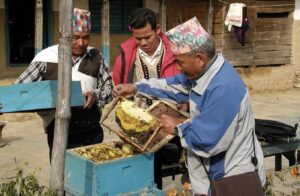
Case studies: In the case of Chitral, Pakistan, ICIMOD introduced honeybees for pollination, and trained farmers to properly manage bee colonies. Similarly, apple farmers in Himachal Pradesh, India, have been using honeybees and practicing beekeeping for managing apple pollination. The state has a government supported organised system for hiring and renting bee colonies for apple pollination. This large-scale use of managed pollination has also established several pollination entrepreneurs not only in Himachal but also in neighbouring states. Currently, the demand of only one-tenth of the required 250,000 colonies to pollinate over 90,000 hectares of apple orchards is being met within the state, indicating a huge scope for the creation of more pollination-based enterprises.
Finance
Information not provided
Innovation
Information not provided
Capacities for design and implementation
Knowledge
The act of beekeeping in the mountains of Nepal goes back to ancient times and is considered a part of Nepal’s cultural heritage. Traditional and indigenous knowledge is important for the future of honeybee management and the conservation of wild honeybee populations, which is at risk of declining in these rural mountain areas.
Knowledge of how to correctly manage bee colonies is necessary. There are different steps to follow for how the bees are introduced or moved, where to place the hives, packing and transportation, what kind of maintenance is required, and how to prevent pesticide poisoning or predators.
Training in honeybee management was delivered and participants were able to learn from local and international experts.
Political / Legal
In India, the Government played a key role in establishing and promoting pollination entrepreneurship by supporting an organised system for hiring and renting bee colonies for apple pollination. This includes a subsidy scheme that helps facilitate the arrangement and upscaling of pollination services led by the State Department of Horticulture of Himachal Pradesh.
Outlook & Scalability
Barriers and adverse effects
Lack of knowledge in rural mountain communities on the importance of existing natural pollinators, and lack of available information and equipment can pose challenges to successful implementation of the beekeeping solution.
In addition, the solution requires adequate knowledge about local bee populations and species, since large-scale migratory beekeeping is controversial and can potentially harm local pollinator populations. For example, introducing the European honeybee species in new areas has reportedly displaced local pollinators. Introducing new pollinators has also increased competition for resources with local pollinator populations in some cases.There is also the risk of disease transfer from managed bee colonies to wild bees. Therefore, managed bees need careful attention and a specific focus on avoiding diseases and competition for forage to avoid negative effects on wild bee populations.
Transformation and future outlook
In areas where integrated crop-livestock farming is a common practice and biodiversity is rich, the pollination service is largely performed by wild bees and other natural pollinators. This means that non-managed bees are just as important for pollination activities. Yet research is ongoing in order to fully understand the impact of managed bees on pollination and on the wild pollinator populations living in surrounding areas. Managed bee pollination is still often thought of as a short-term rather than a long-term solution.
A long-term solution must include changes in agricultural practices to support wild pollinator populations and ensure conservation of habitats to create a long-term win-win situation. The importance of all pollinators, and not only bees, for agriculture and food security in the short and long term needs to be identified and recognized at all levels.
Potential for upscaling and replication
The management of honeybees has already been implemented in various parts of the HKH region (Bangladesh, Bhutan, Pakistan, India and Nepal) where there are crops that both support it and that need bee pollination to survive and thrive. If practised in an environmentally sustainable and locally appropriate manner, the honeybee management solution could be out-scaled to benefit more communities with support from organizations and government. Orchard owners’ associations, research and extension agencies, development partners and universities can all demonstrate the benefits of pollination services and share their learning at various levels.
However, policy reorientation, institutional strengthening and human resources development is needed to further advance pollination services that meet the needs of mountain communities and increase their resilience.
Up-scaling could be achieved by incentivizing beekeepers to manage honeybees in movable hives that can be rented, transported and placed in the crop field. Additionally, policy instruments and institutional mechanisms could facilitate the arrangement of pollination services (e.g. the State Department of Horticulture of Himachal Pradesh has a subsidy scheme for this).
- Learn more: Managed pollination services for increased crop yields and alternative income
- Beekeeping production systems in the Tota Lake basin- Colombia
- Buzz-boosting techniques – The case of beekeeping in the Eastern Arc Mountains of Tanzania
- Bzzzy Earnings – Promoting beekeeping in the Mount Rwenzori region
Comments
There is no contentYou must be logged in to reply.