
Restoring the hydrological functions of mountain agricultural terraces to address multifaceted climate and water-induced disasters

Summary
This solution is based on the journal paper: “Indigenous technology of terraces and its hydrological functions for managing agricultural water and addressing multifaceted climate and water-induced disasters” (attached as a resource). It draws on several field-based studies on various aspects of Indigenous water management technologies and climate change, case studies, an in-depth review of the literature, and over 45 years of experience in managing and studying water resources in mountainous environments in Nepal and other Asian countries in the region.
Please access the original text for more detail, research purposes, full references, or to quote text.
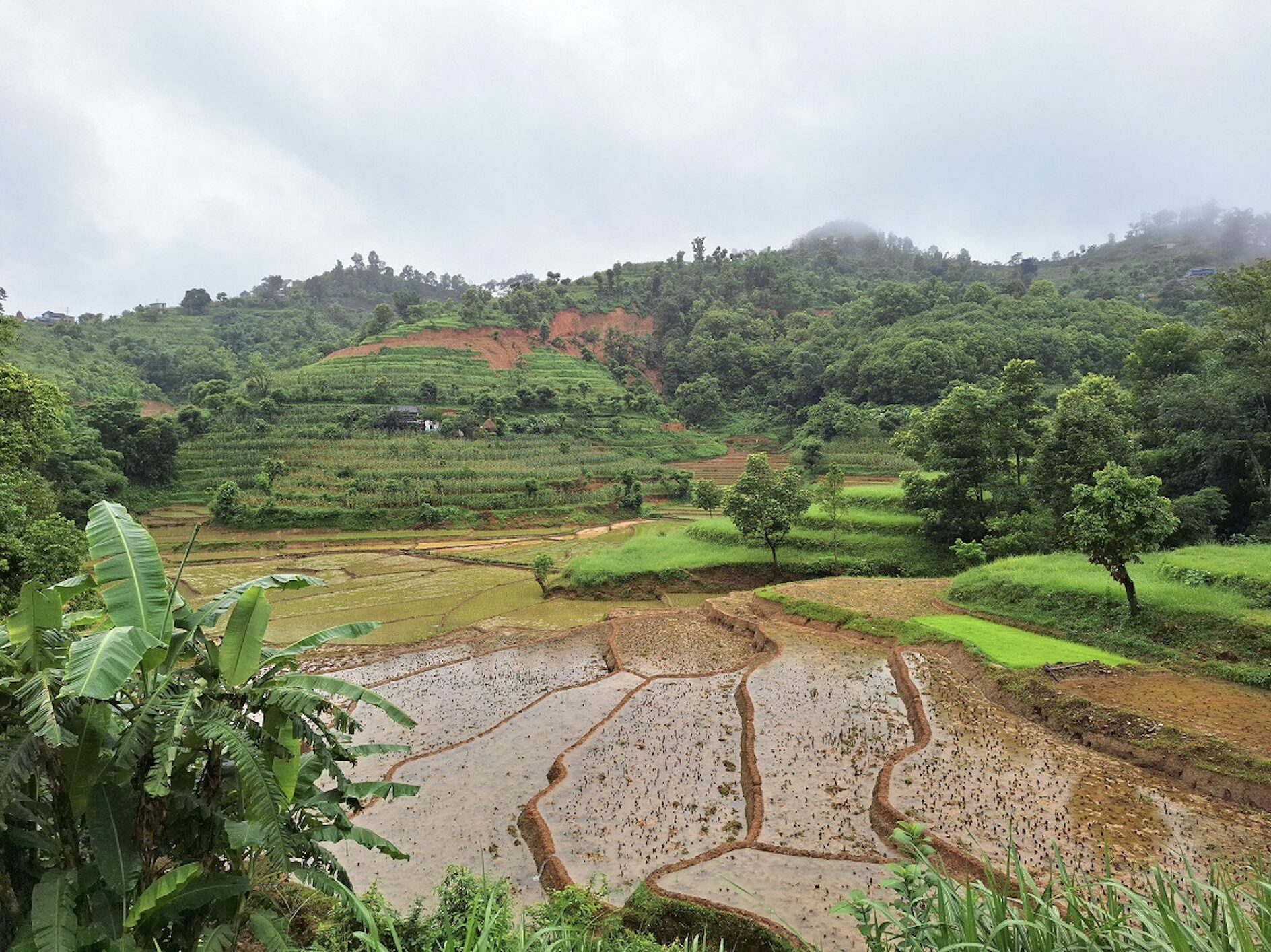
Mountain regions play a vital role in the global hydrological cycle. Agricultural terraces—an indigenous technology developed about 7,000 years ago—enhance this role and reinforce the notion that “mountains are water towers of the plains”. Globally, two types of terraces exist: levelled (paddy) terraces for flooded rice cultivation, and unlevelled (dryland) terraces for upland crops. In Nepal, levelled and dryland terraces cover about 16.8% and 8.3% of mountainous land, respectively.
As agricultural terraces are being abandoned worldwide, their hydrological services are declining, which worsens climate-related impacts such as flash floods and declining stream and spring flows. In Nepal, about 21% of terraces are already abandoned, 60% of which are levelled terraces. Reviving these terraces can restore their hydrological functions, helping reduce floods and enhance downstream water availability.
The solution highlights the lesser-known hydrological functions of agricultural terraces and their ability to mitigate the effects of multifaceted climate and water-induced disasters.
Overview
- Location:
- Implementation sites:
-
- Single country
- Multiple locations
- Mountain region:
-
Hindu-Kush Himalaya
- Solution scale:
- Ecosystem type(s):
- Solution type(s):
- Sector(s):
- Climate impact time-scale(s):
- Main benefit associated with the solution:
- Co-benefit(s) associated with the solution implementation:
- Sendai targets:
-
- SDGs:
-
-


Solution details
Main beneficiaries & outcomes
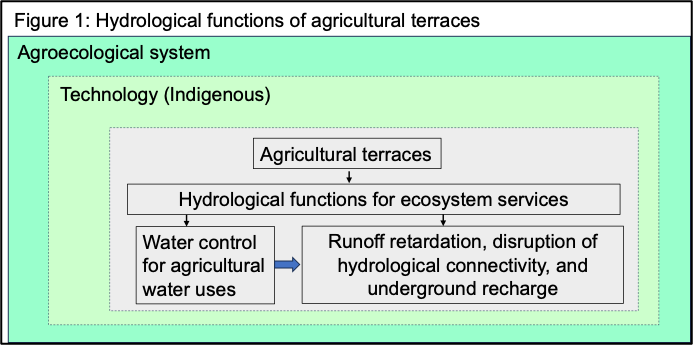
The primary hydrological function of these terraces is water control for agriculture, but they also provide additional services such as runoff retardation, disruption of hydrological connectivity, and underground recharge (Figure 1). These benefit both mountain and downstream communities.
Agricultural terraces for flood alleviation
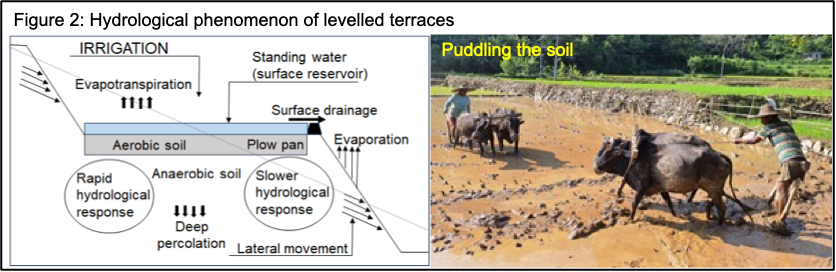
The hydrological phenomenon of levelled terraces is complex—especially in cultivating flooded paddy under an anaerobic condition created by puddling the soil (Figure 2).
The reservoir-like entity of cascaded paddy terraces delays the downstream passage of runoff and simultaneously reduces its volume, leading to alleviation of river flood downstream (Figure 3). In this context, estimates from the Nepalese mountains indicate that a terrace with a 15–20 cm levee can retain 100–150 mm of daily rainfall before spilling, giving a runoff-reduction coefficient of about 80%, similar to findings in India, Vietnam, and China.
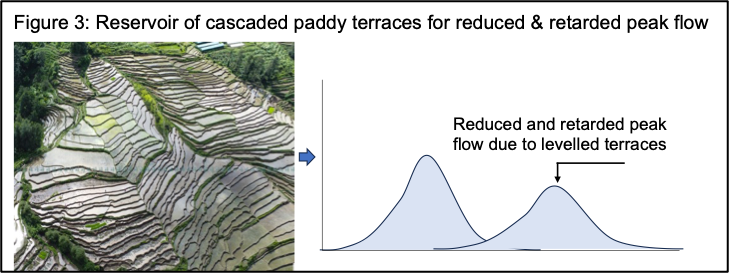
Therefore, for Nepal’s land-use and climate conditions, a 1,000-ha watershed with 16.8% paddy terraces can reduce peak flood flow by about 13.4%. This figure will increase further if the contributions to reduced runoff (due to the reduced connectivity of the runoff flow path and the reduced runoff coefficient of dryland terraces) are accounted for.
Agricultural terraces for water augmentation
Paddy terraces typically retain standing water for about two-thirds of the growing season. Considering an average percolation rate of 30 mm/day (based on the measured and reported percolation rates varying between 22.4 and 64.8 mm per day), paddy terraces covering 16.8% of a 1,000-ha watershed can infiltrate roughly 4.0 million m³ of water annually. This figure will increase further if the contribution from the spring season paddy terraces is also accounted for.
In addition, dryland terraces, covering 8.3% of the watershed, add about 0.5 million m³ of infiltration from an annual rainfall of about 1200 mm. This is due to their transversal plowing and reduced flow connectivity. Considering that half of these infiltrated waters reach waterbodies downstream, the combined areas of paddy and dryland terraces can contribute an additional flow of about 71 l/s to waterbodies downstream.
Planning and implementation
Strategy for reviving agricultural terraces
Analysis suggest that reviving abandoned terraces or converting barren land into terraces will enhance spring and river flows downstream and alleviate river floods.
The strategy should focus on how these terraces can be put back in place for agricultural uses. Agricultural practices of a terrace govern its hydrological outcomes. Given that paddy fields contribute substantially to the intended hydrological benefits compared to the dryland terraces, priorities should be given to producing Indigenous paddy varieties. In Nepal, some such varieties are: Jumli Marshi, Anadi Rice, Pokhreli Masino, Manbhog Rice, etc. Their unique flavour, nutritional benefits, and distinctive taste with organic production can make their farming economically viable. Further, their export also represents a virtual water trade. Other suitable options include cost-effective horticulture, indigenous cereals, agroforestry, and medicinal plants.
Irrespective of the crops proposed, commercial farming through agricultural transformation for enhancing the broader agricultural economy in the area, preferably under an integrated approach with commercial rearing of livestock, should be the priority rather than the subsistence farming being practiced these days.
Finance
Note this solution summary draws on multiple field-based research studies but suggestions for financing are detailed below.
Since the hydrological benefits support both mountain and downstream communities, financing for terraces revival and agricultural transformation can be mobilised through a small levy on commercial water users. In Nepal, the generation of hydropower is one such user whose benefits are attractive. Accordingly, Nepal aims to build 156 plants by 2050 with 25,610 MW capacity and US$63 billion investment. A fraction of its benefit could support terrace revival and agricultural transformation, as these plants will be the main beneficiaries of the said hydrological benefits.
In the case of South Asia, given the transboundary benefits of terraces revival in the Nepalese mountains affecting India and Bangladesh, global climate funds also offer potential financing.
Innovation
Agricultural terraces have provided a wide range of hydrological ecosystem services to communities since time immemorial, yet these functions have not been fully understood or systematically documented. Terraces have largely been treated as a generic land-use category, with limited consideration of their technological characteristics and associated agricultural water management practices. Cropping systems such as flooded rice, irrigated or rain-fed cereals, and tree crops involve distinct water management regimes that influence percolation rates, delayed surface runoff, and disrupted hydrological connectivity across landscapes.
As a key innovative contribution, this research addresses an important and under-represented topic by developing a conceptual framework linking terrace type and agricultural water management practices with their associated hydrological ecosystem services. Improved understanding of these relationships can inform flood mitigation and downstream flow augmentation by promoting the revival of abandoned agricultural terraces as nature-based solutions (NbS) for climate change adaptation.
Capacities for design and implementation
Knowledge
Terrace-related interventions should be guided by modern science combined with indigenous knowledge, such as keyline plowing (practiced in Australia), inward-sloping terraces, and trenches beneath terrace risers.
Institutional
Successful implementation of this solution first requires the formulation of relevant plans, policies, and regulatory provisions. In addition, it demands enhancement of institutional capacities of governments at all levels, the private sector, and communities in terms of institutionalising the plan and policies.
Outlook & Scalability
Barriers and adverse effects
Poor and ineffective institutionalisation of relevant plans and policies could be a barrier.
Potential for upscaling and replication
The potential for upscaling this solution refers to the extent to which agricultural terraces in hill and mountain regions can be systematically revitalized to deliver their intended hydrological benefits. As these benefits are secondary to the primary function of agricultural production, successful upscaling is intrinsically linked to broader agricultural transformation in these areas. In the current context, as living conditions in the hills and mountains have improved considerably due to the development of essential infrastructure, services, and access to modern technologies, compared to the severe hardships experienced by mountain communities in the past, substantial potential exists for agricultural transformation therein. The argument is further reinforced by the observed decline in agricultural production and the growing prominence of food security as a critical concern in many mountainous countries. Consequently, there is an urgent need for appropriate policies, supportive institutional frameworks, and strong commitment to their implementation to enable agricultural transformation in hill and mountain regions. In this regard, undertaking action research in a small but representative watershed – embedded within an ongoing related development project – would be a practical and effective approach to support upscaling and replication.
- Increasing agricultural viability and climate resilience through community seed banks in Nepal
- Resilient women for resilient mountain villages: A holistic approach to climate change adaptation in Nepal
- Adapting to dry spells with low-cost ponds in Nepal
- Reducing vulnerability and increasing adaptive capacity to respond to impacts of climate change and variability for sustainable livelihoods in agriculture sector in Nepal
- The Green Gicumbi project in Rwanda
Comments
There is no contentYou must be logged in to reply.