
Reviving traditional Himalayan water management systems: Climate-resilient adaptation through Zing and Kul systems in the Indian Himalayas


Summary
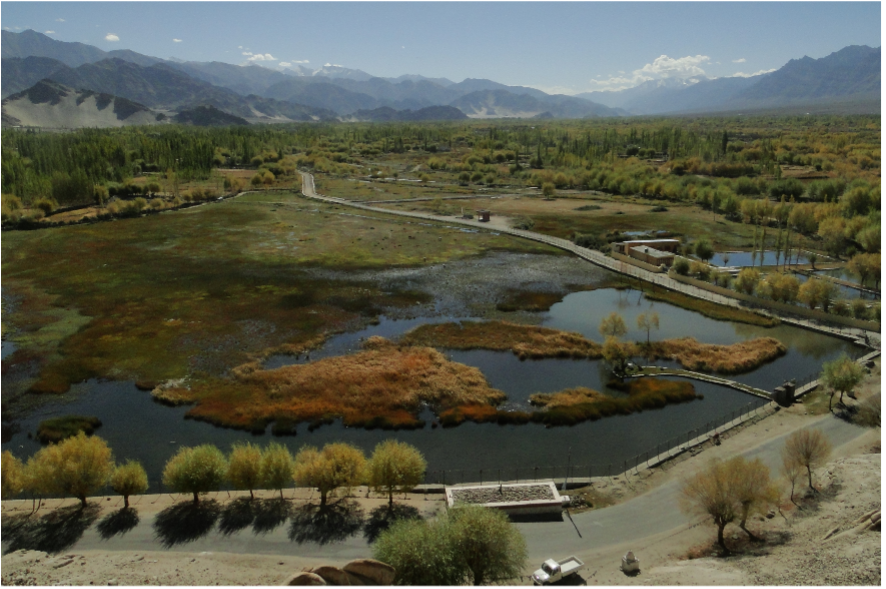
The Zing and Kul systems are indigenous, community-managed water harvesting and irrigation systems that have supported livelihoods and climate resilience in the Indian Himalayan Region for centuries. These traditional systems are primarily practiced in the cold-arid trans-Himalayan regions of Ladakh and Spiti Valley and the cold desert mountain landscapes of Himachal Pradesh. The solution addresses increasing water insecurity, declining agricultural productivity, glacier-fed water variability, drought risk, and climate-induced stress on mountain communities.
The Zing system is a decentralized water harvesting structure designed to capture and store meltwater from glaciers, snowfields, and high-altitude streams during summer months. Zings are generally small, human-made ponds strategically constructed near agricultural fields and settlements. These structures store seasonal runoff and ensure reliable irrigation water availability during short cropping periods in high-altitude cold desert ecosystems. Scientific assessments indicate that a single Zing can store approximately 1,000 m3 of water and support irrigation over nearly 2 hectares of agricultural land. In several Himalayan settlements, the revitalization of Zing systems has contributed to a 30–40% increase in agricultural productivity while significantly reducing vulnerability to seasonal water scarcity.
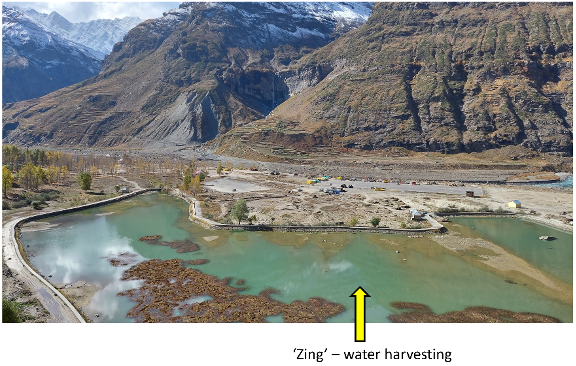
The Kul system is a gravity-fed irrigation network traditionally used in Himachal Pradesh. Kuls are narrow channels that divert water from mountain streams, springs, or glacial melt sources and distribute it across terraced agricultural landscapes. These channels often extend several kilometers and are maintained collectively through community participation and customary governance systems. The Kul system enables efficient water distribution to fields located up to 10 km from source points with comparatively low conveyance losses. In districts such as Kullu and Spiti, the system has supported high-value horticulture and vegetable cultivation, resulting in measurable improvements in household income and food security.

The solution combines indigenous ecological knowledge with modern climate adaptation strategies. Contemporary interventions include channel lining using geomembranes or concrete, installation of underground or PVC-based water conveyance systems to reduce seepage losses, integration of solar-powered pumping systems, artificial glacier and ice stupa technologies, participatory water governance, and smart water monitoring approaches. Community water user associations and local governance institutions play a central role in operation, maintenance, and equitable water allocation.
It also contributes significantly to climate change adaptation (CCA) in mountain ecosystems by enhancing water security, improving agricultural resilience, strengthening local adaptive capacity, conserving traditional ecological knowledge, and reducing climate-related livelihood risks. The approach demonstrates a scalable and low-carbon model of sustainable mountain water management that integrates local knowledge, ecosystem-based adaptation, and decentralized resource governance.
Overview
- Location:
- Implementation sites:
-
- Single country
- Multiple locations
- Mountain region:
-
Himalayas, Trans-Himalayas
- Province:
-
- Ladakh Union Territory, Himachal Pradesh
- Site locations:
-
Leh district, Lahaul district, Spiti Valley
- Solution scale:
- Area Covered:
-
- The systems are distributed across multiple Himalayan valleys and villages; precise cumulative mapped area is not available. Individual Kul networks can extend up to 10 km in length, and Zing systems typically support approximately 2 hectares (0.02 km2) of irrigated agricultural land.
- Ecosystem type(s):
- Solution type(s):
- Climate impact(s) addressed:
- Climate impact time-scale(s):
- Main benefit associated with the solution:
- Co-benefit(s) associated with the solution implementation:
- Sendai targets:
-
-




- SDGs:
-
-





Solution details
Main beneficiaries & outcomes
The principal beneficiaries are smallholder farmers, agropastoral communities, women-led farming households, rural Himalayan settlements, and climate-vulnerable mountain populations in Ladakh and Himachal Pradesh. The systems are community-based and widely accessible within participating villages through customary water-sharing arrangements and collective governance.
Women and elderly populations benefit through improved local water availability, reduced water collection burdens, and enhanced livelihood stability. Youth benefit from improved agricultural opportunities and capacity-building initiatives related to climate-resilient water management. Marginal farming communities and remote settlements particularly benefit because the systems provide irrigation access in areas lacking modern infrastructure. Key outcomes include:
- Increased agricultural productivity by approximately 30–40% in Zing-supported areas
- Improved irrigation reliability during dry seasons
- Enhanced food security and livelihood resilience
- Approximately 25% increase in household income in some Kul-supported horticultural regions
- Reduced vulnerability to drought and climate-induced water stress
- Conservation of indigenous knowledge systems and community institutions
Planning and implementation
The traditional systems have been in operation for several centuries; but revitalization initiatives intensified after 2000.
The planning and implementation process was primarily community-driven, supported by local governance institutions, state government agencies, researchers, and non-governmental organizations. Traditional water managers, village councils, farmers, and local knowledge holders played a central role in identifying water sources, designing storage and conveyance structures, allocating water rights, and maintaining infrastructure.
Implementation activities included:
- Mapping traditional water channels and storage systems
- Assessing glacial meltwater and seasonal stream availability
- Restoration and desiltation of damaged Zings and Kuls
- Reinforcement of channels using modern materials
- Installation of efficient conveyance systems and storage linings
- Formation of water user associations
- Community training on climate-resilient water management
- Integration of artificial glacier and ice stupa technologies in selected locations
- Monitoring of irrigation efficiency and crop productivity
Government initiatives, particularly in Himachal Pradesh, supported rehabilitation through subsidies and technical assistance for Kul restoration and maintenance.
Finance
The solution has primarily been financed through a combination of community labor contributions, state government subsidies, local institutional support, NGO-assisted adaptation projects, and limited research-based funding initiatives. Financial support mechanisms included grants, public subsidies for restoration works, and technical assistance programs.
A few government-supported repair and maintenance programs for Kuls in Himachal Pradesh have significantly improved operational functionality and irrigation coverage. Modernization interventions such as geomembrane lining, solar-powered pumps, and artificial glacier development have generally been supported through climate adaptation and rural development programs.
Precise cumulative project cost data are not publicly available because implementation is decentralized and community-based. Available cost information largely relates to:
- Construction and repair materials
- Channel reinforcement
- Water storage lining
- Labor and excavation
- Solar pumping systems
- Technical training and institutional support
Formal cost-benefit analyses are limited; however, indicators used include:
- Increase in crop yield
- Irrigated land coverage
- Water storage capacity
- Reduction in seasonal water shortages
- Household income enhancement
- Agricultural diversification
The private sector played a limited but emerging role through the supply of materials, solar technologies, and technical services.
Innovation
The key innovative aspect of the solution lies in the integration of indigenous Himalayan water knowledge with modern climate adaptation and decentralized water governance approaches. The systems demonstrate how traditional ecological knowledge can be modernized to address contemporary climate challenges in fragile mountain ecosystems. Major innovations include:
- Climate-resilient glacier meltwater harvesting
- Hybridization of traditional irrigation with modern storage technologies
- Use of geomembranes and PVC conveyance systems to reduce water losses
- Integration of artificial glaciers and ice stupas for seasonal water storage
- Participatory climate adaptation planning
- Low-energy and low-carbon decentralized irrigation systems suitable for remote mountain environments
The solution represents a nature-based and culturally rooted adaptation strategy, suitable for climate-sensitive mountain regions.
Performance evaluation
Performance and impact evaluations have been conducted through academic studies, local observations, and field-based monitoring initiatives. Reported evidence suggests substantial improvements in irrigation reliability and livelihood resilience in restored Zing and Kul systems.
Long term project sustainability and maintenance
The scope of maintenance activities include:
- Annual de-siltation of channels and ponds
- Repair of embankments and diversion structures
- Monitoring of water flow and seepage
- Community-based rotational maintenance schedules
- Seasonal cleaning of irrigation networks
Local communities, village councils, water user associations, and state government agencies are expected to maintain long-term ownership and operational responsibility. Environmental monitoring is important through community observation and increasingly through scientific assessments of glacier meltwater availability and irrigation performance.
The sustainability of the systems depends on continued community participation, climate adaptation investments, institutional support, and integration with watershed/springshed management programs.
Capacities for design and implementation
Knowledge
Traditional ecological knowledge formed the foundation of system design, water allocation, seasonal management, and infrastructure maintenance. Scientific research contributed to improving storage efficiency, reducing water loss, and adapting systems to climate variability. Capacity-building programs and technical training have strengthened local adaptive capacity.
Technology
Technologies such as geomembrane linings, PVC pipes, GIS-supported watershed assessments, solar-powered pumps, and smart irrigation systems improved the effectiveness and resilience of traditional systems.
Political / Legal
Government support through rural water management policies, climate adaptation initiatives, and irrigation subsidy programs facilitated restoration and modernization efforts. Administrative support and policy recognition are important considerations for successful implementation.
Institutional
Collaboration among local communities, government departments, NGOs, researchers, and technical experts is central to implementation. Community-based water governance and participatory decision-making mechanisms also enhanced institutional coordination.
Socio-cultural
Strong socio-cultural cohesion, customary water-sharing systems, collective labor traditions, and community stewardship may play a vital role in sustaining the systems. Local participation and social acceptance significantly enhanced implementation effectiveness.
Outlook & Scalability
Barriers and adverse effects
Key barriers included:
- Declining glacier and snowmelt availability
- Population pressure
- Outmigration and reduced traditional labor availability
- Land-use changes
- Infrastructure degradation
- Limited financial resources
- Increasing climate variability in the Himalayas
These barriers may partially be overcome through modernization interventions, institutional support, government subsidies, and participatory governance.
Potential adverse effects may include:
- Local conflicts over water allocation during extreme water scarcity
- Unequal access where governance mechanisms weaken
- Ecological disturbances if over-extraction occurs
- Reduced effectiveness under severe long-term glacier retreat scenarios
Transformation and future outlook
The solution strengthened climate adaptation in Himalayan mountain regions by transforming traditional systems into climate-resilient, community-centered water management. It enhanced adaptive capacity, water security, agricultural sustainability, and local institutional resilience. Future resilience may depend on (a) continued glacier and watershed monitoring, (b) climate-resilient infrastructure modernization, (c) diversification toward less water-intensive crops, (d) integration with regional adaptation planning, and (e) expansion of artificial glacier and water conservation initiatives. The systems are well-suited to coping with both slow-onset climate change and rapid hydrometeorological variability.
Potential for upscaling and replication
Upscaling is highly desirable due to the low-cost, decentralized, and environmentally sustainable nature of the solution. Replication potential exists across climate-sensitive mountain regions with seasonal water scarcity and glacier-fed hydrology. Requirements for scaling include: (a) policy integration within climate adaptation and watershed management plans, (b) financial incentives and technical assistance, (c) capacity building and community training, (d) scientific monitoring and hydrological assessments, and (e) integration of indigenous and modern engineering approaches. Elements of the solution align strongly with National Adaptation Plan priorities, ecosystem-based adaptation strategies, and mountain resilience initiatives.
- The Water Act, Bhutan: sustainable water management
- Spring revival: A nature-based solution to improve water security and climate resilience in the Hindu Kush Himalaya
- Restoring the hydrological functions of mountain agricultural terraces to address multifaceted climate and water-induced disasters
- Automated Ice Reservoirs (AIRs) for Climate-Resilient Water Security in High-Altitude Communities
- Water Resources Scenario of Indian Himalayan Region (Huda et al., 2019)
- A Review of Indian Traditional Method of Rain Water Harvesting (More, 2021)
- Traditional Knowledge of Water Management in Himalayan Region–Innovative Technological Interventions (Raina and Sharma, 2019)
- Water Harvesting and Conservation under Cold Desert Condition of Ladakh (J&K): Constraints and Strategies (Tundup et al., 2017)
Comments
There is no contentYou must be logged in to reply.