
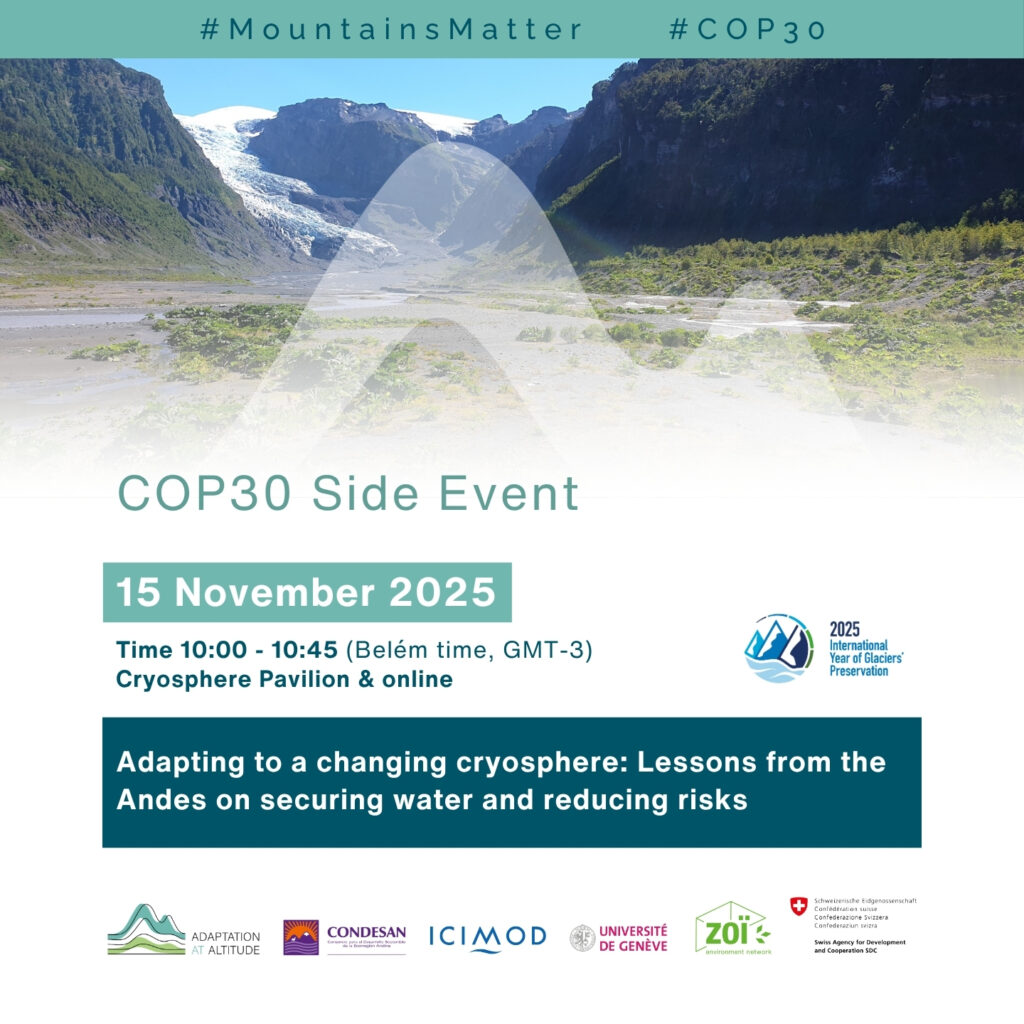
COP30 – Adapting to a changing cryosphere: Lessons from the Andes on securing water and reducing risks




Date and Time
Location: Cryosphere Pavilion & online
Date: 15 November 2025
Time: 10:00 – 10:45 (Belém time, GMT-3)
About the event
At the Cryosphere Pavilion during UNFCCC COP30, this side event brought together experts to discuss mountain adaptation in a changing cryosphere. Using examples from the Andes and beyond, the session highlighted solutions for enhancing resilience, securing water, and managing risks — and showed how local successes can shape global adaptation strategies.
Keynote by
Julia Aguilera Rodríguez, Scientist, University of Geneva
Panel discussion with
Luis Daniel Llambí, Programme Coordinator, CONDESAN
Pradyumna J.B. Rana, Intervention Manager – Global Engagement, ICIMOD
Román J. Baigún, Wetlands International LAC
Moderated by
Johanna Zwahlen, Project Manager, Zoï Environment Network
The event is available on the Cryosphere Pavilion’s Youtube channel.
Key insights from the discussion
Building on findings from a recent evaluation of community-led wetland restoration in Argentina, the panelists shared key factors for successful adaptation actions and solutions around the world, and discussed how local lessons can inform global adaptation policies and funding mechanisms. Key insights from the discussion included:
- Local knowledge and ownership are essential for sustainable adaptation action.
- Women’s leadership is critical, as they play a central role in managing wetlands and rangelands.
- Collaboration across scales, sectors and institutions strengthens impact: Linking local actions with national and regional policies, fostering dialogue among stakeholders, and establishing transparent agreements with local authorities is key.
- Regional cooperation is essential. Shared cryosphere monitoring in the Hindu Kush – Himalaya region and integrated data efforts in the Andes are examples that demonstrate how collaboration helps countries respond to common challenges and promotes knowledge exchange.
- Inter-regional collaboration: By facilitating knowledge exchange and ensuring that local lessons inform global negotiations, inter-regional cooperation helps advance mountain adaptation priorities at the international level.
Comments
There is no contentYou must be logged in to reply.