Beekeeping production systems in the Tota Lake basin- Colombia



Summary
The objective of this adaptation measure is to strengthen the resilience of agricultural productive systems in the Lake Tota basin and to diversify the livelihoods of farming families through the integration of ecosystem services and productive systems. It was implemented by the Adaptation to the Impacts of Climate Change on the Water Resources of the Andes (AICCA) Project (https://aicca.condesan.org/colombia/). AICCA is funded by the Global Environment Facility (FMAM/GEF), implemented by CAF – Development Bank of Latin America (CAF) – and executed by the Consortium for the Sustainable Development of the Andean Ecoregion (CONDESAN).
Among the most valued ecological relationships is the one between plants and bees, as it’s estimated that 35% of global food production comes from bee-pollinated crops. Changes in temperature and rainfall are among the factors that most affect ecosystems, for example, changes in vegetation phenology, which in turn creates imbalances in pollinators and their ecological dynamics.
In the Lake Tota basin, climate change scenarios show that for the period 2026-2050, the wet scenario would present changes in rainfall, increasing between 15% and 40%, and the dry scenario would show reductions between 10% and 20%. Regarding mean, maximum, and minimum temperatures, it was found that all would increase by 0.5 to 1°C. Furthermore, with respect to climate variability, changes are expected to be increasingly significant: in the projected period, there would be increases of more than 100% in precipitation or reductions of 80%.
According to the Main Ecological Structure analysis, the greatest threats are determined by the loss of areas with natural cover and soil degradation due to mass removal and floods, which generates conflicts over land and water use. A “Very high” threat was established for the change of natural cover of 556.0 hectares due to anthropogenic activities in the páramo zone, and a “High” threat for 1,701.4 hectares, corresponding to areas in high Andean forest that lost natural cover between 1986 and 2019. This study determined that 1,092.1 hectares exceed the carrying capacity to a severe degree of overuse, and 1,908.0 hectares are close to exceeding their use capacity, showing a level of soil exploitation above what is recommended.
These projected and current changes in climate, coupled with the permanent loss of natural covers and soil overuse due to agricultural practices, increase vulnerability and climate risk, as they directly affect ecosystem services of water provision and regulation, and food security. Some of the impacts generated by the above are water deficit, alterations in soil characteristics, land use conflicts, changes in the behavior of flora and fauna species, ecosystem imbalance, and the detriment of livelihoods in the basin.
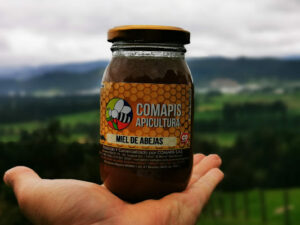
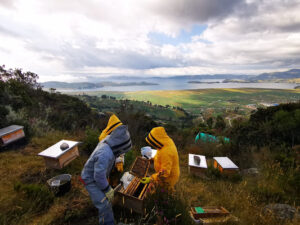
The beekeeping production system was implemented within the Lake Tota basin as a measure to diversify agricultural activities. With this, pollination services within strategic ecosystem areas are improved, and ecological restoration processes are favored. The beekeeping production system consisted of installing apiaries with 5 to 20 beehives and an apicultural training process. The latter is based on permanent technical assistance to build capacities in managing productive units and capturing swarms for the production of honey, pollen, and propolis. Value-added by-products are developed from beekeeping products, focusing on specialized market niches.
Overview
- Location:
- Implementation sites:
-
- Single country
- Single location
- Mountain region:
-
Andes
- Province:
-
- Boyacá
- Site locations:
-
Municipio Aquitania/Vereda Pérez
Municipio Sogamoso/ Vereda Las Cintas I
Municipio Sogamoso/ Vereda Las Cintas II
Municipio Tota/ Vereda Toquechá
Municipio Tota/ Vereda Tota
Municipio Aquitania/ Vereda Suse
- Solution scale:
- Ecosystem type(s):
- Solution type(s):
- Sector(s):
- Climate impact(s) addressed:
- Other climate impact(s) addressed:
-
- Changes in temperature/rain patterns, Strong winds, Unsustainable use of resources, Ecosystem loss, Food security, Economical dependence
- Climate impact time-scale(s):
- Main benefit associated with the solution:
- Other benefit(s) associated with the solution implementation:
-
- The main benefit associated with the implementation is the diversification of traditional production systems in the Lake Tota basin, for the reduction of vulnerability in the dimension of food security and biodiversity. With the implementation of this solution, the community's adaptive capacity is increased, and the resilience of agricultural systems and the pollination ecosystem service are improved. This encourages the implementation of low-impact soil practices in high Andean forest ecosystems in the face of predominant climate variations. Additionally, it contributes to reducing impacts due to economic dependence on monoculture spring onion farming.
- Co-benefit(s) associated with the solution implementation:
- Sendai targets:
-
- SDGs:
-
-
Solution details
Main beneficiaries & outcomes
Beekeeping in Tota Lake. Credit: AICCA
The main beneficiaries of the solution are medium and small producers of spring onions, potatoes, and livestock, strategically located in extreme areas of the basin. The solution is widely available, it was implemented with women, men, and youth. Beneficiaries have the capacity to replicate the solution, carry out designs, and plan production according to the conditions of the property or farm.
Planning and implementation
The main organization in charge of planning and implementation: The planning and implementation process was led by the Project on Adaptation to the Impacts of Climate Change on Water Resources in the Andes (AICCA), which is funded by the Global Environment Facility (GEF), implemented by the Development Bank of Latin America (CAF), and executed by the Consortium for the Sustainable Development of the Andean Ecoregion (CONDESAN). In Colombia, the project is executed jointly with the Ministry of Environment and Sustainable Development (Minambiente) and the Institute of Hydrology, Meteorology and Environmental Studies (IDEAM). In the implementation component, the company COMAPIS SAS was involved.
The methodology for the design and implementation of the measure can be generally summarized as follows:
- Socio-environmental diagnosis: an analysis of the territorial context of the study area’s relevant aspects was developed, characterizing the main productive systems, ecosystems, actors, level of governance, and climate risk analysis, among others.
- Development of the Territorial Analysis for Adaptation: inputs were integrated into the analysis to define adaptation needs in the territory.
- Beneficiary selection: a general review of the communities within the properties categorized with medium and high susceptibility from the previous analysis was carried out, and a survey of rootedness, vulnerability, and dependence was applied to them, which allowed prioritizing the communities that require this type of adaptation measure.
- Participatory design and implementation of apiaries: during this process, the vegetation cover, access roads, general characteristics, water sources, and nearby establishments of each property were reviewed. This was done to select the most suitable place for the establishment of the apiaries.
- Training process: the process of establishing apiaries, in the case of Lake Tota, is structured together with a complete training program, which aims to establish productive and commercial chains for the by-products obtained in the beekeeping system. In this sense, the following activities were carried out:
- Group practical sessions,
- Technical talks,
- Individual training sessions,
- Experience exchanges,
- Marketing processes.
- Strengthening in the area of producer networks for the sustainability of the processes.
Finance
The project was funded by the Global Environment Facility (GEF). Funding was provided as a Grant. The total cost of the solution (basic unit: 1 beekeeping production system consisting of 5 beehives, equipment, and materials) was 3700 USD.
Innovation
The key innovative aspect of the solution, particularly with respect to CCA in mountains: The adaptation measure of beekeeping production systems focuses on sustainable production. This activity showed positive productive indicators in very cold climate ecosystems, from 3,100 to 3,400 m.a.s.l. This is consistent with the basin’s floristic availability for a dry period from September to April 2022. This allows inferring a wide spatio-temporal mobility for the A. mellifera species in the short term. The products obtained in honey and pollen have very differentiated organoleptic characteristics, which facilitates commercialization at prices higher than the market average for similar products. With the implementation, income was generated during the dry season of the year, where farmers traditionally do not produce due to impacts from climate variability, such as droughts and frosts.
Long term project sustainability and maintenance
It is planned to maintain the productive cycle for 5 years. Long term ownership/costs will be assumed by small and medium-sized producers, who are part of the beneficiary community.
Capacities for design and implementation
Knowledge
Scientific and local knowledge played a decisive role in the solution. For zone definition, spatial integration was carried out, including: climate variability and change scenarios, definition of the Main Ecological Structure (MEP), pressure factors, vulnerability and risk analysis, of the Lake Tota basin. This determined areas susceptible to the implementation of adaptation measures in the sectors of natural systems, economic activities, and education. Finally, existing and potential adaptation measures were prioritized according to the effectiveness criteria established by the Friends of Ecosystem-based Adaptation (FEBA) network, and subsequently evaluated considering gender analysis, actors, and conflicts.
Technology
For the design, the use of Geographic Information Systems (GIS) was fundamental, particularly for the territorial analysis for adaptation.
Political / Legal
The development of this solution was articulated within the framework of the National Climate Change Policy, specifically aligned with the strategic line of management and conservation of ecosystems and ecosystem services for low-carbon and climate-resilient development. Furthermore, within the framework of the National Adaptation Plan, guidelines were established to address planned adaptation, including: implementing adaptation measures. Finally, at the local level, the National Council of Economic and Social Policy (CONPES) document, 3801 of 2014, regulates the environmental management plan for the Lake Tota basin, among its objectives is to increase the development of sustainable productive processes and the diversification of products in the Lake Tota basin. This national framework motivated local teams for the development of this solution and facilitated the justification for its implementation.
Institutional
The local partners for the implementation of the beekeeping production system measure were the Municipal Mayor’s Office of Aquitania and Tota and the beneficiaries. The coordination mechanism was established through framework agreements for the development of climate change adaptation measures. Subsequently, tripartite agreements were signed, where commitments were defined by the parties to guarantee adequate coordination in implementation and sustainability, which has been successful, as it has allowed for adequate management with the local community.
Socio-cultural
Within the framework of the project’s governance and sustainability strategy, guidelines were established to generate participatory construction spaces with the communities and jointly evaluate the specific needs related to climate variability and climate change.
Outlook & Scalability
Barriers and adverse effects
The main barrier to the implementation of the solution were the cultural beliefs about insects. This was overcome by conducting training processes, experience exchanges, and permanent accompaniment until local capacities were built with the beneficiaries.
Transformation and future outlook
With the development of the solution, impacts related to accentuated climate changes will be faced, allowing the adaptive capacity of rural communities to be increased and their resilience improved. This is because its implementation offers production alternatives to diversify income, improve the pollination ecosystem service, and favor the times for the consolidation of ecological restoration processes.
Potential for upscaling and replication
It is desirable to expand the solution to improve the times in the growth of plant cover and crop quality. It motivates improved productive practices for pesticide control and the protection of pollinators in the basin. Due to its low investment, producers can easily replicate the solution.
Comments
There is no contentYou must be logged in to reply.